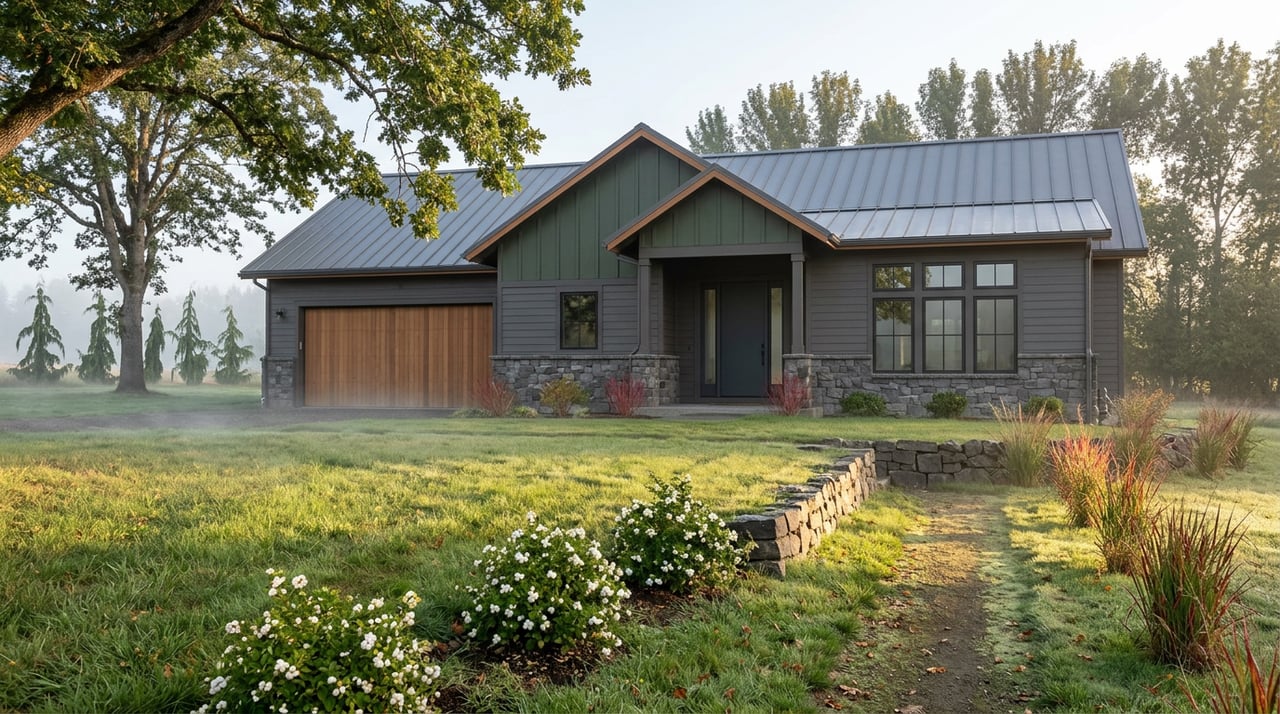
A buyer shopping five-acre parcels in northern Clark County will hit the same wall eventually. Two listings, similar house size, similar acreage, similar fencing and outbuildings. One sits inside Battle Ground's orbit. The other sits eight or ten miles north, past Yacolt. The Battle Ground listing costs more per acre, sometimes considerably more, and the natural assumption is that someone is pricing it wrong.
Nobody is pricing it wrong. The two listings are selling different products that happen to share a square-footage number and a fence line.
The Land Isn't the Product You're Buying
Clark County's rural acreage market runs on a hierarchy that has nothing to do with soil quality. Hockinson and Brush Prairie sit at the top, commanding the highest per-acre premiums in Southwest Washington's horse country because they combine acreage with the shortest possible drive to Vancouver and the I-205 corridor. Battle Ground occupies the middle tier: still rural enough for a shop, a well, and pasture, but close enough to hold a sub-40-minute commute to Portland. Yacolt and Amboy anchor the discount end, where land is genuinely cheaper because the buyer is trading proximity for space.
Across the county, five- to ten-acre horse properties with real infrastructure, fencing, and cleared pasture typically run somewhere between $90,000 and $180,000 per acre, with the wide range driven almost entirely by how much built equestrian infrastructure is already in place. Amboy listings currently average closer to $94,800 per acre. Battle Ground trades above that Amboy average, and Hockinson trades above Battle Ground. Same rural zoning category in most cases. Different bundle.
Three Tiers, Three Different Products
| Tier | Markets | What the premium buys |
|---|---|---|
| Premium | Hockinson, Brush Prairie | Shortest commute to Vancouver and I-205, deepest concentration of covered arenas and training facilities |
| Middle | Battle Ground | Sub-40-minute Portland commute, full-service groceries and medical within minutes, active new construction pipeline |
| Discount | Yacolt, Amboy | Lowest per-acre cost, genuine distance from suburban Clark County, a permanent green buffer at the county's northern edge |
Yacolt is the clearest illustration of what you give up at the discount end. It is one of the smallest incorporated towns in the county, with a single traffic light and a population under 2,000. Most residents drive eight miles south into Battle Ground for groceries, medical care, and schools, and another 28 miles to reach Vancouver for anything more specialized. The Yacolt Burn State Forest, roughly 110,000 acres of public land, forms a permanent boundary to the north. That boundary is part of the appeal for buyers who want a guarantee that nothing gets built behind them, but it also means Yacolt's inventory stays thin, typically 12 to 20 active listings at any given time, which makes comparable sales harder to find and pricing harder to pin down without local guidance.
What the Extra Miles Buy
Battle Ground sits roughly 14 to 15 miles north of Vancouver and about 24 miles from Portland, which typically works out to a 20 to 25 minute drive into Vancouver and 30 to 35 minutes into Portland under normal traffic. Yacolt sits closer to 28 miles out from Vancouver, and most of its residents already drive eight miles just to reach Battle Ground for groceries, a pharmacy, or a doctor's appointment. That distance is not a footnote on the listing sheet. It is the second half of the price, showing up as a lower number per acre and a longer number in the driveway-to-desk math every single day.
This is also why acreage buyers who fixate on the lowest possible per-acre number sometimes end up disappointed. The land was never the only line item. The distance was priced in from the start.
What Dollars Corner Is Already Pricing In
There is a second, forward-looking piece to Battle Ground's premium that Yacolt and Amboy simply do not have: an active urban growth boundary expansion sitting on the city's western edge.
Dollars Corner is a roughly 640-acre area along State Route 502 that Battle Ground has proposed folding into its urban growth area, primarily to accommodate job growth rather than housing. Under the city's 2045 comprehensive plan update, which was still moving through joint hearings with Clark County as of January 2026, the corridor is intended to accommodate close to 12,000 additional residents and more than 5,600 new jobs over the next twenty years, with Battle Ground's own adoption waiting on the county finalizing its countywide plan first. Once the area sits inside the urban growth boundary, state law allows annexation if 60 percent of property owners petition to join the city.
The city is already spending ahead of that growth. In its 2026 federal legislative agenda, Battle Ground requested more than $10 million in federal support, including a $4 million ask specifically to reconstruct Southwest Eaton Boulevard between Southwest 20th Avenue and State Route 503, a stretch the city has identified as one of its highest-crash corridors and one that does not currently meet minor arterial standards. That kind of infrastructure spending on a growth corridor is not decorative. It is the city signaling where it expects development pressure to land next, and buyers holding acreage near that corridor are, whether they realize it or not, holding a position on that bet.
One Median, Two Markets
Here is where the data gets genuinely interesting, and where a single headline number would mislead you. Public listing data through the summer of 2026 shows Battle Ground's median list price clustering somewhere between roughly $538,000 and $592,000 depending on the exact month and methodology, a range wide enough that quoting any single figure without context is close to meaningless.
The days-on-market figure tells the more useful story. Some measures show homes moving in 37 to 68 days depending on price tier, with well-priced listings in the $500,000 to $700,000 range still drawing multiple offers and a sale-to-list ratio near 99.5 percent. Other broader measures put the median days on market closer to 120 to 130 days across the same period.
Both numbers are true at once, because Battle Ground is not one market. It is a fast-moving suburban tier of standard-lot single-family homes stacked on top of a slower-moving acreage and rural tier where thin inventory, larger price tags, and a more selective buyer pool stretch the timeline. When you average those two tiers together, you get a median that describes neither one accurately. If you are shopping acreage specifically, the 120-day figure is closer to your reality than the 40-day figure, and pricing your own expectations off the wrong tier is the single most common mistake acreage buyers and sellers make here.
How to Actually Compare Two Acreage Listings
When two rural listings look similar on paper but land far apart on price, work through the comparison in this order rather than starting with the barn or the view:
- Zoning first. Confirm the parcel's Rural-5 or Rural-10 designation and what it actually permits, since not every rural-zoned acre supports the same use.
- Water second. A well with documented rights is worth more than an unverified one, regardless of acreage.
- Pasture and drainage third. Cleared, well-drained pasture commands a real premium over raw or wooded acreage of the same size.
- Infrastructure fourth. Fencing, shops, and arenas add value, but only after the first three items check out.
- Septic and setbacks last. These affect buildability but rarely explain a large price gap on their own.
Buyers who reverse that order, starting with the shop or the arena, tend to overpay for the wrong parcel and undervalue the one that actually works.
FAQ
Is cheaper per-acre land in Yacolt or Amboy actually a better deal than Battle Ground? It depends entirely on what you value. If your priority is maximum acreage per dollar and you do not need a daily commute, the discount tier can be a genuinely better fit. If a sub-40-minute Portland commute or same-day access to groceries and medical care matters, the Battle Ground premium is buying something real, not padding the price.
Will the Dollars Corner expansion change Battle Ground's rural character? The expansion is aimed at employment and industrial land use along State Route 502, not at converting existing rural residential acreage. For now it functions as a long-term demand driver for nearby property rather than an immediate change to zoning on established rural parcels, though buyers considering land close to that corridor should track the process through Clark County's public hearings as it continues to move forward.
If you are weighing acreage across Battle Ground, Yacolt, or anywhere else in Clark County and want a clearer read on what a specific parcel's price is actually bundling, Oxford Street Partners can walk through the comparison with you. Book a consultation and let's figure out what you're really paying for before you write an offer.