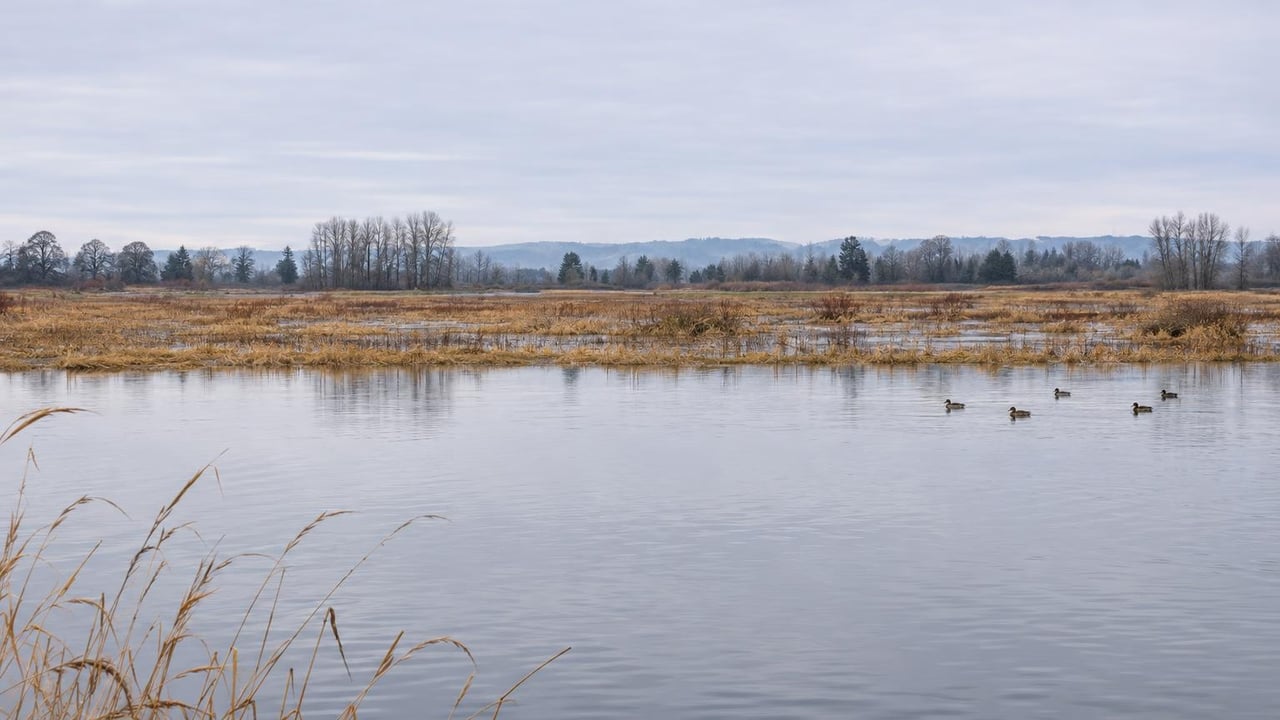
Every winter evening, over 5,000 gulls fly in to roost on an island in the middle of Vancouver Lake. They leave again at dawn. The island is a leftover from the dredging that deepened the lake. Before that work and the flushing channel that brings Columbia River water in, the lake's 2,800 acres were less than three feet deep. The gulls are one show in a winter season that sits a short drive west of Felida's front doors. Vancouver Audubon says birding in the Vancouver Lowlands is best from early fall through late spring, when the wintering species gather.
The whole season fits in one morning. A loop from La Frambois Road out along Lower River Road takes in diving ducks at the water treatment plant, grebes at the flushing channel and cranes in the fields. It ends at one of two county parks joined by a paved trail, and parking at both is free tomorrow and on Dec. 5.
Two County Parks and the Trail Between Them
Vancouver Lake Regional Park and Frenchman's Bar Regional Park are both open from 7 a.m. to dusk. A 2.5-mile paved trail links the two parks.
Clark County charges a $5 daily parking fee year-round at both parks. The fee also applies at Lewisville Regional Park and at Salmon Creek Regional Park/Klineline Pond. Walking or cycling in costs nothing.
Two of the county's 2026 fee-free days fall in the next ten days. The first is tomorrow, Friday, Nov. 27, which the county has named Green Friday. The second is Saturday, Dec. 5, International Volunteer Day. Fee-free days are new this year. The county picked dates that differ from the state parks' free days, so the county has more free days on public land overall. If you'd rather spend the day after Thanksgiving on the levee than at the shops, the parking is free.
If you'll be back often, the 2027 County Parks annual parking pass went on sale Nov. 17 for $40 and is valid through Dec. 31, 2027. Fort Vancouver Regional Libraries also lends county parks parking passes in its free Check Out Washington backpacks. Holds can be placed at fvrl.org.
Inside Vancouver Lake Park, the planted trees and dense shrubs attract migrant and wintering songbirds. A trail at the north end of the park is lined with roses and thick brush that shelter many sparrows. It leads into an Oregon ash forest where roosting owls or hawks sometimes turn up. At Frenchman's Bar, the levee trail looks over the Cranes Landing fields east of the park, where you can scan for sandhill cranes. One December, Ken Pitts photographed a Pacific loon on the Columbia River from Frenchman's Bar.
The Wildlife Land North and East of the Lake
North and east of the lake, the ground belongs to the Washington Department of Fish and Wildlife. WDFW calls the Vancouver Lake Unit an important Pacific Flyway wintering area for waterfowl and a staging and wintering area for sandhill cranes. You reach it by La Frambois Road off Fruit Valley Road. Across the wider Shillapoo Wildlife Area, the winter regulars are Canada geese, mallards and other dabbling ducks. Bald eagles are sometimes present in large numbers. WDFW says most cranes stage here in fall and spring, and a few stay through the winter.
According to Vancouver Audubon's lowlands guide, tundra swans, geese and sandhill cranes can be plentiful along the Vancouver Lake and Shillapoo shoreline road when hunters are absent. WDFW describes the neighboring Shillapoo North Unit as a major wintering area for waterfowl in the Pacific Flyway. It takes in the northern part of the drained Shillapoo lakebed and about 1.5 miles of Lake River shoreline, and someday its farm fields are to be restored to wetland. The unit has roadside pullouts along Highway 501 and Lower River Road, and current access details are on WDFW's Shillapoo North page.
The Drive West, Stop by Stop
Vancouver Audubon's lowlands guide, written by Wilson Cady and revised by Randy Hill in August 2024, lays out a loop. It's a handy order for a winter morning.
The loop starts on La Frambois Road, reached from Fruit Valley Road by Fruit Valley Park. At the northeast corner of the water treatment plant, the guide suggests scanning for wintering waterfowl, including large numbers of ruddy ducks and other diving ducks. The road continues into the Shillapoo Wildlife Area, where the guide suggests checking the power lines for raptors. The shooting range has a large parking area with trails into the interior wetland. Past it, at the boat launch, another trail heads west closer to the lake. From the launch you can scope most of Vancouver Lake, depending on water levels. You can see as far as the sand beach at the county park and the distant east shore, where grebes, cormorants and gulls gather in large flocks.
Back on SR-501, the route bears onto NW Lower River Road, which has as many as ten access points with trails or roadside views. A paved walking trail on the south side of the road keeps pedestrians away from traffic. The guide suggests checking the ponds and fields along the way for geese, ducks, great egrets and sandhill cranes. About 3.3 miles along, a parking lot on the right overlooks the flushing channel. The fresh river water draws fish, and the fish draw western and horned grebes, common mergansers and double-crested cormorants, which winter there. A red-necked or Clark's grebe sometimes turns up among them. Lynne Heidsiek photographed a western grebe at the mouth of the channel on Dec. 11, 2024. When the lake is low, thousands of birds can crowd the shallows toward the gull island.
Where SR-501 turns left onto Lower River Road, stay straight on the SR-501 spur, the Erwin O. Rieger Memorial Highway. The Vancouver Lake County Park entrance is 0.6 mile ahead on the right. Ending the loop here puts the songbird trail and the ash forest at the finish. Tomorrow and on Dec. 5, parking is free there.
The geese are worth more than a glance. The guide says the big flocks of cackling and Canada geese can include five or more subspecies. Careful scanning can turn up greater white-fronted, snow and Ross's geese, and on rare occasions an emperor goose.
A Lake With Work Still Under Way
Clark County finished Phase 2 of the Vancouver Lake Management Plan in 2025. That phase covered a beach-management pilot, work on invasive species and an analysis of options for flushing the lake. The county put Phase 3 on hold after state funding was withdrawn. It said partner coordination, beach management, milfoil treatment and investigations into pollution sources would continue. In August 2025, Friends of Vancouver Lake announced that the Port of Vancouver and Clark County were teaming up to treat invasive milfoil in the lake.
The county notes that the lake has had periodic closures linked to cyanobacteria. Before any visit that involves the water, check the Vancouver Lake Regional Park page for current notices. Heavy rain can also change plans. In December 2025, The Columbian reported that an atmospheric river closed some Clark County roads and parks.
The Winter Calendar, in Order
Vancouver Audubon has lined up a run of dates that fits this season.
- Friday, Nov. 27: fee-free parking at Vancouver Lake and Frenchman's Bar.
- Tuesday, Dec. 1: a Vancouver Audubon bird outing on the Salmon Creek Greenway Trail.
- Saturday, Dec. 5: a Young Birders outing at Frenchman's Bar, on the county's last fee-free day of 2026.
- Dec. 14 through Jan. 5: Christmas Bird Count season.
- Monday, Jan. 4: the Sauvie-Ridgefield Christmas Bird Count. Registration is through Vancouver Audubon's community science page.
- Feb. 12–15: the Great Backyard Bird Count, which a Felida bird feeder counts toward as well.
For something more regular, Vancouver Audubon's Winter Raptor Survey asks volunteers to drive a set route once a month from December through February. For a second winter outing farther north, we've written about winter at the Ridgefield refuge, and our summer guide to Felida has more on the neighborhood's own trails.
At Oxford Street Partners, we follow what's happening at Vancouver Lake and around Felida as closely as we follow the market. If you'd like to talk about life near the lowlands, a morning on the flushing channel included, we'd be delighted to hear from you. Book a Consultation and we'll put the kettle on.